
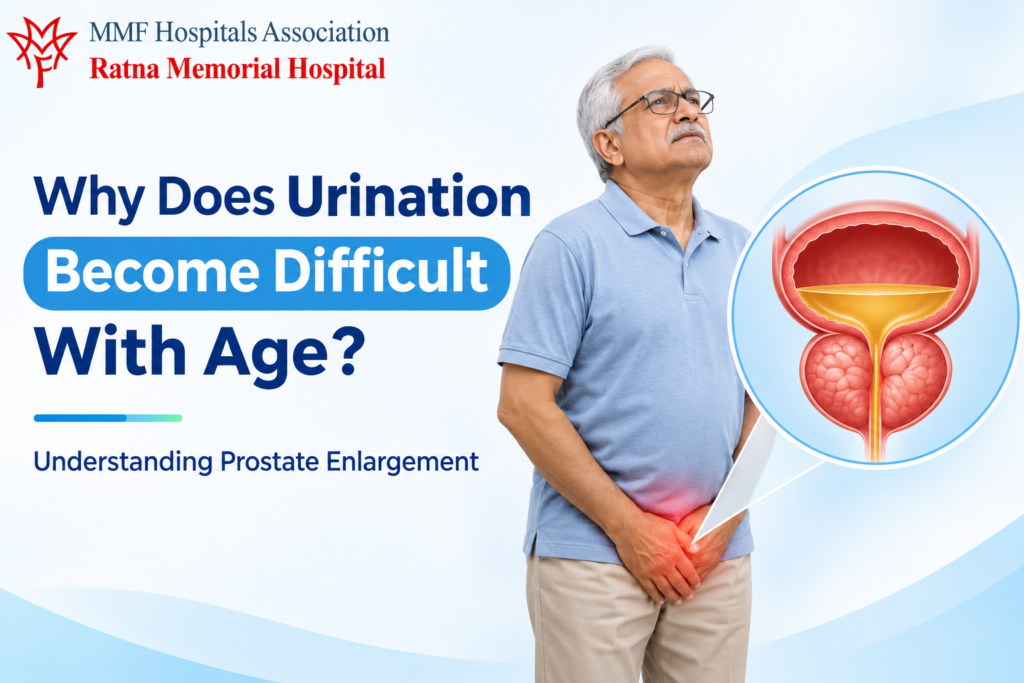
As men grow older, changes in urinary habits are common. Some may notice that their urine flow has become weaker, while others experience difficulty starting urination, frequent bathroom visits, or the feeling that their bladder is never completely empty.
Although these symptoms may develop gradually, they should not automatically be considered a normal part of ageing.
One common reason for these changes is benign prostatic hyperplasia (BPH), a non-cancerous enlargement of the prostate gland that becomes more common with age.
At Ratna Hospital, Pune, raising awareness about age-related urinary problems is an important step towards helping patients recognise symptoms and seek appropriate medical evaluation.
What Is Prostate Enlargement?
The prostate is a small gland located just below the urinary bladder. It surrounds the urethra, the tube that carries urine from the bladder out of the body.
As men age, the prostate may gradually increase in size. This condition is known as benign prostatic hyperplasia or BPH.
When the prostate enlarges, it can press against the urethra and interfere with the normal flow of urine.
This may cause symptoms such as a weak urinary stream, delayed urination, or difficulty emptying the bladder.
Importantly, an enlarged prostate is not the same as prostate cancer. However, similar urinary symptoms can occur in different prostate and bladder conditions, making proper evaluation essential.
NIDDK+1
Why Does the Prostate Enlarge With Age?
The exact cause of prostate enlargement is not completely understood. However, age-related hormonal changes are believed to play an important role.
The prostate may continue growing throughout adulthood, and the likelihood of enlargement increases with age.
Several factors may be associated with prostate enlargement.
1. Natural Ageing
Prostate enlargement becomes increasingly common after the age of 50.
As the prostate grows, it may place pressure on the urethra and make urine flow more difficult.
2. Hormonal Changes
Changes in male hormone activity may contribute to prostate tissue growth.
Dihydrotestosterone (DHT), a hormone derived from testosterone, is involved in prostate development and growth.
3. Family History
Men whose close family members have experienced prostate enlargement may have a greater likelihood of developing the condition.
4. Other Health Factors
Conditions such as obesity and metabolic disorders may be associated with urinary symptoms and prostate enlargement.
However, these factors do not mean that every older man will develop troublesome prostate symptoms.
What Are the Common Symptoms of an Enlarged Prostate?
The symptoms of prostate enlargement usually develop gradually and may become more noticeable over time.
Common warning signs include:
-
Weak urine stream: Urine flows more slowly than usual.
-
Difficulty starting urination: It takes longer to begin passing urine.
-
Frequent urination: The need to visit the bathroom increases.
-
Night-time urination: Waking repeatedly during sleep to urinate.
-
Incomplete bladder emptying: Feeling that urine remains in the bladder.
-
Intermittent urine flow: Urination starts and stops unexpectedly.
-
Urinary urgency: Experiencing a sudden, strong urge to urinate.
-
Post-urination dribbling: Small amounts of urine leak after finishing.
The severity of symptoms does not always correspond to prostate size. Some men with a relatively large prostate experience few symptoms, while others with smaller enlargement may have significant urinary difficulties.
How Does Prostate Enlargement Affect Urination?
To understand why urination becomes difficult, it helps to understand how the bladder and prostate work together.
Normally, the bladder contracts to push urine through the urethra.
When the prostate becomes enlarged, it may narrow the urethral passage and increase resistance to urine flow.
The bladder then needs to work harder to empty itself.
Over time, this additional pressure may contribute to changes in bladder function.
Some patients may experience:
-
Reduced urine flow.
-
Increased urinary frequency.
-
Difficulty emptying the bladder.
-
Sudden urinary urgency.
-
Urine retention in more severe cases.
These symptoms can affect sleep, travel, work, and overall quality of life.
Is Difficulty Urinating Always Caused by Prostate Enlargement?
No. Although an enlarged prostate is a common cause of urinary difficulty in older men, other medical conditions can produce similar symptoms.
These may include:
Urinary tract infections: Infections can cause frequent urination, urgency, discomfort, or burning.
Bladder dysfunction: Changes in bladder muscle or nerve function may affect urine storage and emptying.
Urethral stricture: Narrowing of the urethra can restrict urine flow.
Prostatitis: Inflammation of the prostate may cause urinary discomfort or difficulty.
Prostate cancer: Some symptoms may overlap with those of benign prostate enlargement, although early prostate cancer often causes no symptoms.
A medical examination is necessary to determine the underlying cause rather than assuming all urinary changes are related to ageing.
How Is Prostate Enlargement Diagnosed?
A urologist may recommend investigations depending on the patient’s symptoms, age, health history, and examination findings.
| Diagnostic Test | Purpose |
|---|---|
| Urine examination | Checks for infection, blood, or other abnormalities. |
| PSA blood test | May help assess prostate-related concerns when clinically appropriate. |
| Digital rectal examination | Helps assess prostate size and physical characteristics. |
| Ultrasound | Evaluates the prostate, bladder, and remaining urine when indicated. |
| Uroflowmetry | Measures urine flow rate and pattern. |
| Post-void residual measurement | Checks how much urine remains after urination. |
Not every patient needs all these tests. A urologist determines which investigations are appropriate based on individual circumstances.
What Are the Treatment Options for an Enlarged Prostate?
Treatment depends on symptom severity, prostate size, associated complications, and the patient’s overall health.
1. Lifestyle Modifications
Men with mild urinary symptoms may benefit from simple changes, including:
-
Reducing excessive caffeine and alcohol consumption.
-
Limiting fluid intake shortly before bedtime while staying adequately hydrated during the day.
-
Maintaining a healthy body weight.
-
Avoiding unnecessary delays in urination.
-
Managing constipation.
-
Reviewing medications that may worsen urinary symptoms with a doctor.
These measures may help improve symptoms but do not necessarily reduce prostate size.
2. Medications
Doctors may recommend medicines to improve urinary flow or manage prostate enlargement.
Common medication categories include:
Alpha-blockers: Help relax muscles around the prostate and bladder neck, making urination easier.
5-alpha-reductase inhibitors: May gradually reduce prostate size in suitable patients.
Medication choice depends on symptoms, prostate characteristics, medical history, and potential side effects.
3. Minimally Invasive Procedures and Surgery
If symptoms are severe, medications are ineffective, or complications develop, a urologist may recommend a procedure.
Depending on clinical suitability, options can include transurethral resection of the prostate (TURP), laser-based procedures, or other minimally invasive treatments.
Not every person with an enlarged prostate requires surgery. Treatment decisions should be individualised.
NIDDK+1
Can Untreated Prostate Enlargement Cause Complications?
Prostate enlargement is generally a benign condition. However, significant urinary obstruction may sometimes lead to complications.
Possible problems include:
-
Acute urinary retention.
-
Recurrent urinary tract infections.
-
Bladder stones.
-
Persistent incomplete bladder emptying.
-
Bladder dysfunction.
-
Kidney problems in severe cases involving prolonged obstruction.
Early evaluation can help identify patients at risk of complications.
When Should You Consult a Urologist?
Men experiencing persistent urinary changes should consider medical evaluation, particularly when symptoms interfere with sleep or daily activities.
Consult a healthcare professional if you notice a progressively weaker urine stream, frequent night-time urination, difficulty starting urination, or persistent incomplete bladder emptying.
Seek urgent medical attention if you cannot pass urine at all, experience severe lower abdominal pain, notice blood in your urine, or develop fever and chills with urinary symptoms.
These symptoms may require prompt investigation and treatment.
Prostate Enlargement Evaluation at Ratna Hospital, Pune
Age-related urinary problems can affect comfort, confidence, sleep quality, and everyday activities.
Understanding the underlying cause is essential because not all urinary difficulties are related to prostate enlargement.
At Ratna Hospital, patients experiencing urinary symptoms can enquire about available urology consultations, diagnostic assessment, and appropriate treatment options.
Individuals looking for information about prostate enlargement treatment in Pune can visit Ratna Hospital’s official website to learn more about the hospital and its services.
Website: https://ratnahospital.in/
Conclusion
Difficulty urinating with age is commonly associated with an enlarged prostate, but it should never be ignored or assumed to be an unavoidable part of growing older.
A weak urine stream, frequent urination, night-time bathroom visits, and incomplete bladder emptying may indicate benign prostatic hyperplasia or another urinary condition.
With timely assessment, lifestyle modifications, medication, and appropriate treatment when necessary, many men can manage urinary symptoms effectively.
Frequently Asked Questions (FAQs)
1. Why does urination become difficult after the age of 50?
One common reason is benign prostate enlargement. As the prostate increases in size, it may narrow the urethra and interfere with urine flow. Other bladder or urinary conditions can also contribute.
2. Is prostate enlargement a normal part of ageing?
Prostate growth becomes more common with age, but not every man develops symptoms. Persistent urinary difficulties deserve medical evaluation.
3. Can an enlarged prostate become cancerous?
Benign prostatic hyperplasia is not prostate cancer and does not itself increase prostate cancer risk. However, both conditions can occur independently, so concerning symptoms should be evaluated.
4. Can prostate enlargement be treated without surgery?
Yes. Many patients can manage symptoms through lifestyle adjustments and prescribed medicines. Surgery or another procedure may be needed in selected cases.
5. Does drinking less water improve prostate symptoms?
Reducing excessive fluid intake before bedtime may help night-time urination, but restricting fluids too much can cause dehydration and other health problems.
6. When is prostate enlargement dangerous?
Prostate enlargement needs urgent attention if it causes complete inability to pass urine. Other concerning signs include blood in the urine, severe pain, or fever with urinary symptoms.