
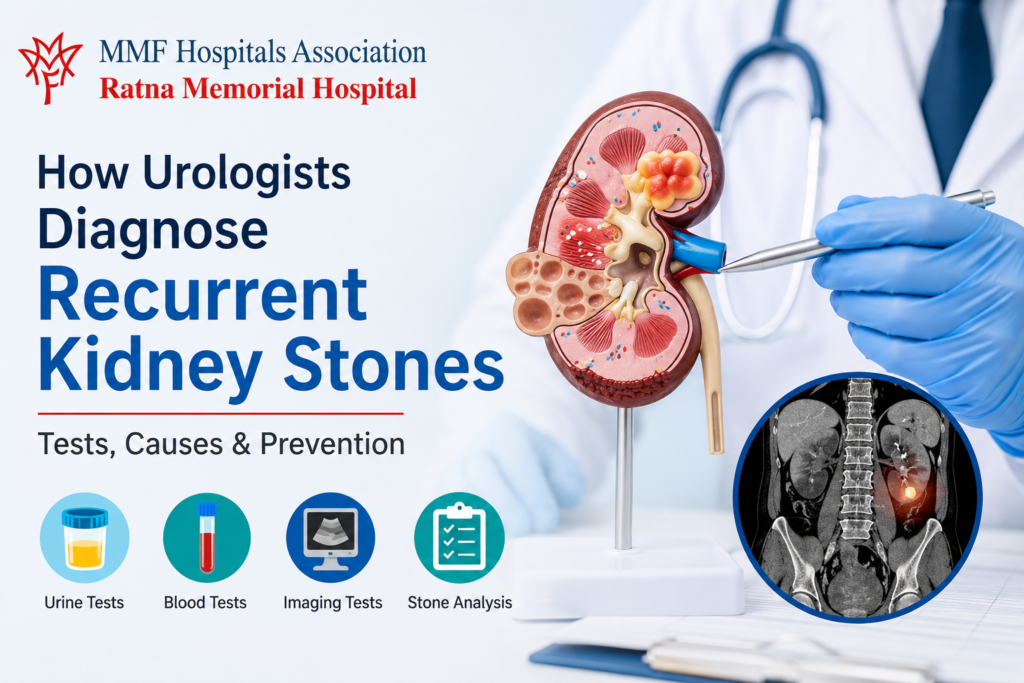
Understanding Stone Evaluation at a Trusted Urology Hospital in Pune
Passing or removing a kidney stone can bring immediate relief, but it does not always solve the underlying problem. Some people develop another stone within months or years because the factors responsible for stone formation are still present.
Recurrent kidney stones require more than a scan to confirm their location. A urologist investigates why the stones are returning, identifies their composition and assesses whether a medical condition, dietary pattern, urinary abnormality or anatomical problem is contributing to their formation.
At Ratna Memorial Hospital, patients with recurring stones can receive a detailed evaluation to guide treatment and long-term prevention. Consulting a qualified urologist in Pune is particularly important when stones return repeatedly, occur in both kidneys or are associated with infection, obstruction or declining kidney function.
What Are Recurrent Kidney Stones?
Recurrent kidney stones are stones that form again after a previous stone has passed naturally or been removed through treatment. A person may develop the same type of stone repeatedly or experience stones with a different composition.
The most common types include:
- Calcium oxalate stones
- Calcium phosphate stones
- Uric acid stones
- Infection-related struvite stones
- Cystine stones caused by an inherited condition
The type of stone matters because each one has different risk factors and may require a different prevention strategy. For example, advice that helps prevent a uric acid stone may not be sufficient for someone forming infection-related stones.
A previous stone episode is itself an important risk factor for another episode. Therefore, recurrent stones should not be treated as isolated events without investigating the cause.
Why Do Kidney Stones Keep Returning?
Kidney stones form when certain substances become highly concentrated in the urine. These substances may crystallise, gradually grow and form a stone. Low urine volume is a common contributor, but recurrence can have several causes.
Possible risk factors include inadequate fluid intake, excessive dietary salt, a high intake of certain animal proteins, obesity, recurrent urinary infections and a family history of stones. Some people absorb or excrete unusually high amounts of calcium, oxalate, uric acid or cystine.
Certain medical conditions may also raise the risk. These include overactive parathyroid glands, gout, inflammatory bowel disease, chronic diarrhoea and disorders affecting the way nutrients are absorbed. Previous intestinal or weight loss surgery can alter oxalate absorption in some patients.
The evaluation conducted by a urologist in Pune is intended to separate occasional lifestyle-related risk from an ongoing metabolic, infectious or structural cause.
The First Step: A Detailed Medical History
The diagnostic process usually begins with a detailed conversation. The urologist in pune asks about previous stone episodes, treatments, infections and relevant health conditions.
Important information may include:
- The age at which the first stone developed
- The number and frequency of stone episodes
- Whether stones occurred in one or both kidneys
- Previous procedures such as ureteroscopy, RIRS, ESWL or PCNL
- Family history of kidney stones
- Daily fluid intake and dietary habits
- Regular medicines and nutritional supplements
- History of gout, bowel disease, urinary infections or endocrine disorders
Patients should bring their previous scan reports, laboratory results, discharge summaries and stone analysis reports to the consultation whenever possible. Comparing current and older scans can help the doctor understand how quickly new stones are developing.
Physical Examination and Symptom Assessment
A physical examination may not reveal a small kidney stone directly, but it helps assess the patient’s general condition and identify possible complications.
The urologist will ask about flank or back pain, painful urination, blood in the urine, nausea, fever and changes in urinary frequency. Fever with chills, severe pain, vomiting or difficulty passing urine may indicate obstruction or infection and can require urgent medical attention.
Blood pressure, hydration status and tenderness around the kidney area may also be evaluated. The findings help determine which investigations should be performed and how urgently treatment is needed.
Urine Tests for Recurrent Kidney Stones
A routine urine test can provide valuable information about stone formation. It may detect blood, crystals, infection, urine acidity and other abnormalities.
A urine culture may be ordered if infection is suspected. This test identifies the bacteria responsible and helps the doctor select an appropriate antibiotic. Recurrent infection is especially relevant because certain bacteria can encourage the formation of struvite stones.
Urine pH is another important finding. Persistently acidic urine may encourage uric acid stones, while highly alkaline urine can be associated with certain calcium phosphate or infection-related stones.
However, a single urine sample offers only a snapshot. Patients with repeated stones may require a more detailed metabolic evaluation.
Why Is a 24-Hour Urine Test Important?
A 24-hour urine test measures everything passed in the urine over an entire day. It can reveal abnormalities that may not appear in a routine sample.
The test may measure:
- Total urine volume
- Calcium
- Oxalate
- Uric acid
- Citrate
- Sodium
- Creatinine
- Urine pH
Low citrate can increase stone risk because citrate naturally helps prevent crystals from joining together. High urinary calcium, oxalate or uric acid can also encourage stone formation. A high sodium result may indicate excessive salt intake, which can increase calcium loss into the urine.
The results allow the urologist to provide personalised advice instead of giving every patient the same restrictive diet. In some cases, two separate 24-hour collections may be recommended to obtain a more reliable picture of the patient’s usual urine chemistry.
Blood Tests Used in Stone Evaluation
Blood tests help assess kidney function and identify metabolic conditions that may be contributing to recurrence.
Tests may include kidney function parameters such as serum creatinine, along with calcium, uric acid, electrolytes and bicarbonate. If the blood calcium level is elevated, the doctor may investigate parathyroid hormone levels to check for an overactive parathyroid gland.
These investigations are particularly important when stones occur frequently, begin at a young age, affect both kidneys or are accompanied by reduced kidney function.
Imaging Tests Used to Locate Kidney Stones
Imaging shows the number, size and location of stones. It can also reveal urinary obstruction, swelling of the kidney and anatomical abnormalities.
Ultrasound
Ultrasound does not use radiation and can identify many kidney stones as well as swelling caused by obstruction. It is frequently used for initial evaluation and follow-up, although very small stones or stones in certain parts of the ureter may be difficult to see.
Non-Contrast CT Scan
A non-contrast CT scan can detect most urinary stones with high accuracy. It helps determine the exact size, density and location of a stone and can identify obstruction or other possible causes of pain.
Because CT involves radiation exposure, the urologist considers the patient’s history, symptoms and previous imaging before recommending it. Low-dose protocols may be considered when clinically appropriate.
X-Ray
Some calcium-containing stones are visible on an X-ray, while uric acid stones usually are not. X-rays may sometimes be used to monitor known radiopaque stones or assist with treatment planning.
The kidney stone treatment service at Ratna Memorial Hospital includes diagnostic assessment and treatment planning based on the stone’s size, position and clinical impact.
Stone Analysis: Testing the Stone Itself
If a patient passes a stone, it should be collected in a clean container and taken for laboratory analysis if advised. Stones removed during a procedure may also be sent for testing.
Stone analysis identifies its chemical composition. This information can confirm whether the stone is primarily made of calcium oxalate, uric acid, struvite, cystine or another substance.
The result is combined with blood tests, urine findings and dietary history to develop a targeted prevention plan. Without stone analysis, prevention may rely on assumptions rather than the patient’s actual stone type.
When Is a More Detailed Evaluation Needed?
A comprehensive evaluation is especially important for patients who:
- Develop stones repeatedly or at a young age
- Have stones in both kidneys
- Have a solitary kidney or reduced kidney function
- Experience recurrent urinary infections
- Have a family history of frequent stone formation
- Develop large, multiple or rapidly growing stones
- Have bowel disease, gout or a suspected metabolic disorder
Children, pregnant patients and people with complex medical conditions may require an individually planned diagnostic approach.
What Happens After the Cause Is Identified?
Diagnosis is followed by a personalised prevention and treatment plan. Depending on the findings, the urologist may recommend increasing fluid intake, reducing sodium, modifying specific foods or taking prescribed medication.
Patients should not unnecessarily eliminate all calcium-containing foods. Very low dietary calcium can increase oxalate absorption in some people. Dietary changes should be based on the stone type, urine results and medical history.
If an existing stone is causing obstruction, infection, persistent symptoms or kidney damage, active treatment may be necessary. Available options can include ureteroscopy, RIRS, shock wave treatment or PCNL, depending on the stone’s characteristics. Ratna Memorial Hospital also provides information about lithotripsy treatment in Pune for suitable cases.
Consult a Urologist in Pune for Recurrent Kidney Stones
Repeated kidney stones are often a sign that an underlying risk factor has not yet been identified or adequately controlled. A structured evaluation involving medical history, urine testing, blood investigations, imaging and stone analysis can help explain why stones are returning.
Ratna Memorial Hospital is a trusted Urology Hospital in Pune offering comprehensive care for kidney stones and other urinary conditions. Its urology services include diagnostic facilities, specialist evaluation and modern treatment options. Patients experiencing recurrent stones can consult the hospital’s team of urologist in pune for an individual assessment and prevention plan.
Frequently Asked Questions
1. Which tests does a urologist recommend for recurrent kidney stones?
The evaluation may include a routine urine examination, urine culture, blood tests, ultrasound and a non-contrast CT scan when required. A 24-hour urine collection and laboratory analysis of a passed or removed stone may also be recommended to identify the factors responsible for recurrence.
2. Can kidney stones return even after surgery?
Yes. Surgery removes the existing stone but may not correct the reason it formed. Low urine volume, abnormal urine chemistry, dietary factors, infection or an underlying medical condition can lead to new stones. Follow-up with a urologist is important after stone removal.
3. When should recurrent kidney stone symptoms be treated as an emergency?
Seek urgent medical care if stone symptoms occur with fever, chills, persistent vomiting, inability to pass urine, severe uncontrolled pain or reduced urine output. A blocked urinary system combined with infection can become serious and requires prompt evaluation.
4. Is a 24-hour urine test necessary for every kidney stone patient?
It may not be required after every first-time, uncomplicated stone episode. It is more commonly advised for recurrent stone formers, high-risk patients or people with multiple, bilateral or unusual stones. The urologist decides based on the individual risk profile.
5. Can drinking more water completely prevent kidney stones?
Adequate hydration is one of the most important preventive measures, but it may not be sufficient for everyone. Some patients also need dietary changes, infection management or medication based on their stone composition and metabolic test results.
For recurrent kidney stones or concerning symptoms, consult a qualified urologist for personalised evaluation and treatment.